
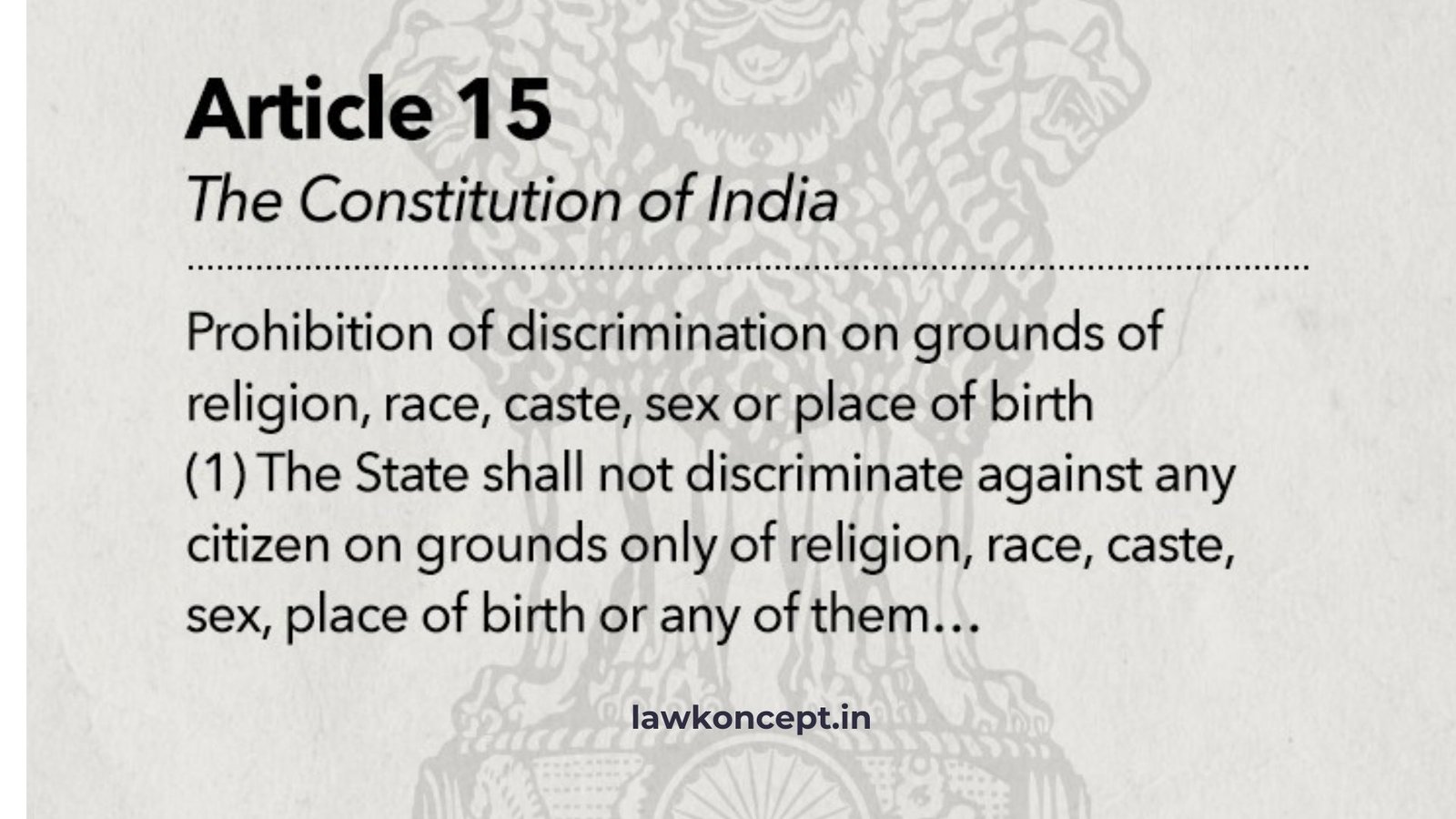
Article 15
Article 15 of Indian Constitution is given under Part III of the Constitution of India. This article covers the crucial provision against targeting any citizen to grounds of discrimination. That is based on religion, race, sex, caste and place of birth.
It is one of the most basic rights which guarantees equality in the Indian Society, that is why it falls under the category of fundamental rights. It prohibits the discrimination on specified grounds. It also gives power to the State to make special provisions for women, children, backward sections, Scheduled Castes, Scheduled Tribes and weaker sections.
Citizens should be provided with equal facilities of shops, hotels, restaurants, entertainment poles, water facilities and roads. In this article we will cover in detail regarding Article 15 of Indian constitution and its interpretation with its importance.
What Is Article 15?
This is one of the articles appearing in the Fundamental Rights chapter, and aims to prevent discrimination by the State against citizens on the basis of different types of grounds. It is a constitutional guarantee against discrimination in public life and the use of public spaces.
Put plainly, Article 15 states that the State shall not discriminate against or favor any citizen on the grounds of religion, race, caste, sex or place of birth. It also prohibits discrimination in access to shops, restaurants, hotels, institutions and the like.
Text and Scope
The numerous clauses in Article 15 make for a robust equality scheme. At its heart is the rule in clause (1) which treats State discrimination as constitutionally wrong, and in clause (2) which also covers ‘public places’ and ‘public utilities’.
The article applies to citizens and is broader than many people think because it is not only limited to direct denial of opportunity but also prohibits disabilities, restrictions or conditions related to the various bases.
Clause-Wise Breakdown
Article 15(1)
The State shall not discriminate against any citizen- on grounds only of religion, race, caste, sex, place of birth, or any of them.
Article 15(2)
No citizen shall, by reason of these alone, be liable to disable, burden, restriction or condition of access to shops, restaurants, hotels and places of public entertainment or to public well, tank, bathing ghat, road or any other public resort.
Article 15(3)
The State shall make special provision for women and children. This paragraph implies that equality might call for support or protection in certain cases.
Article 15(4)
The State can bring forward special provisions for the advancement of socially and educationally backward classes, Scheduled Castes and Scheduled Tribes. This provision was inserted following the model of the early constitutional litigations on reservations.
Article 15(5)
The State shall make special provisions, including reservations for admission to the all educational institutions, including private educational institutions, but excluding minority educational institutions.
Article 15(6)
This clause enables special provisions for Economically Weaker Sections, such as 10% reservation in educational institutions (denominations are limited by constitutional and statutory conditions)
Important Exceptions
Article 15 is not a complete prohibition against all kinds of differentiation. The Constitution prescribes positive steps and special provisions for uplifting distressed and backward sections of society.
These exceptions are important for they demonstrate that Article 15 is about substantive equality and other than non-discrimination.A different treatment of its subjects can be authorized if the legislator aims at eradicating past unequal treatment.
Important Cases
The following was the leading case:
A significant case is “Indra Sawhney v. Union of India”, a leading case that established Indian reservation jurisprudence. This case is often cited along with Article 15 and equality principles.
Following this in 2018, “Navtej Singh Johar v. Union of India” broke the definition of equality in the context of the Constitution and added sexual orientation and gender identity to the definition of “sex.”
“State of Madras v. Champakam Dorairajan (1951)” Reservation on the basis of caste in educational institutions was held a violation of Article 15(1) leading to First Constitutional Amendment protecting reservation under Article 15(4).
“Ashoka Kumar Thakur v. Union of India(2008)” Upheld OBC reservation in private colleges under art 15(5).
Article 15 Movie
Article 15 movie is directed by Anubhav Sinha, with starer by Ayushmann Khurrana. This is a brave real-life-inspired social drama movie that shines a light on discrimination and injustice. Towards the people based on their caste in the heartlands of India. This movie features an IPS officer who upon looking into the disappearance and rape of young girls in the country finds deep secrets.

Therefore, in the process of this social commentary, Article 15 raises pertinent questions about an age-old- constitutional vow of equality – the same from which the film has been named, and provides it with life through hard-hitting cinematic portrayal, leaving the viewer reflective.
Article 15 vs Article 14
While Article 14 lays down the principle of equality before law and equal protection of laws, that of 15 is specific as it forbids discrimination on certain grounds.
One easy way to remember the difference: Article 14 expresses the general rule of equality and Article 15 is a specific anti-discrimination provision concerning the particular social grounds.
FAQ
1. Is Article 15 available to all persons?
Art.15 expressly prohibits only the “people” from discrimination using any of the specific grounds.
2. Does Article 15 only apply to the government?
Yes, the primary restriction in clause (1) is directed towards the State with clause (2) giving effect to the right concerning access to public places and public facilities.
3. Can the State make reservations under Article 15?
Yes, there are exceptions in (4), (5) and (6) for backward classes, SCs, STs and EWS. Art 15(3) allows for special treatment for women and children.
4. What is the main purpose of Article 15?
Aims to eliminate discrimination and doctrine of equality but permits such measures as affirmative action wherever necessary in achieving social justice.
5. Which grounds of discrimination are prohibited under Article 15?
The primary impermissible criteria are those of religion, race, caste, sex and place of birth.