
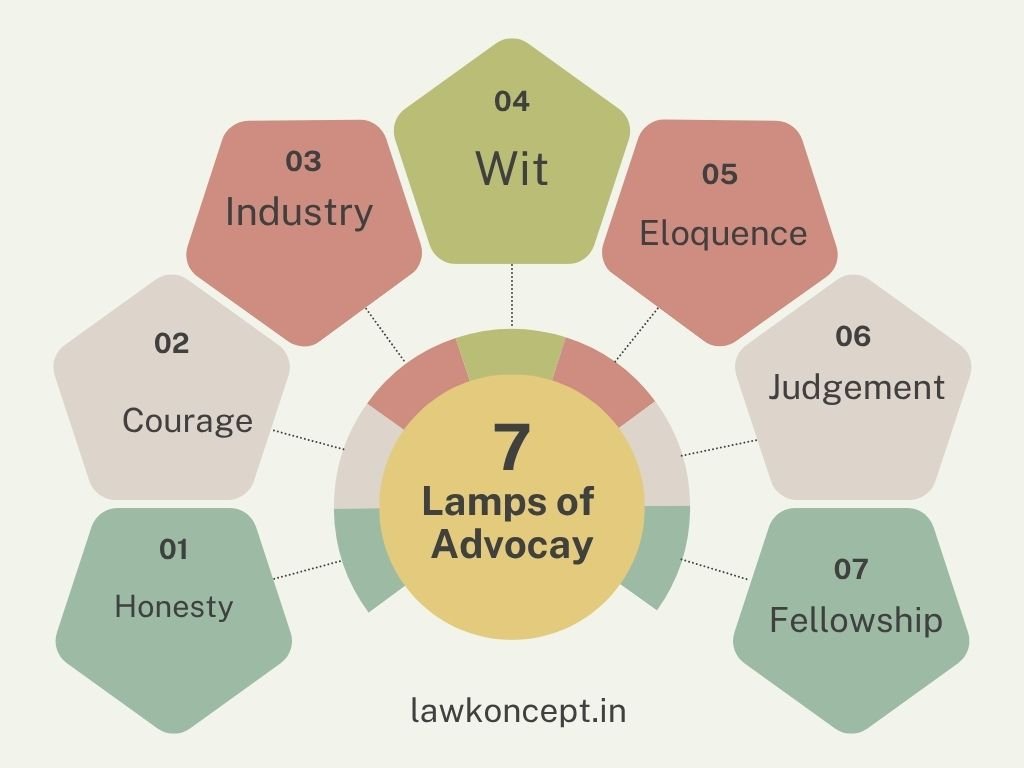
The legal profession is based on ethics. The main idea of this profession is to follow professional standards and ethical rules. There are several important qualities that advocates must follow in order to help keep the law and justice working properly in society.
In the field of “professional ethics of advocacy,” these qualities are known as the “Seven Lamps of Advocacy.” Some of them are honesty, cleverness, skill, good speaking skills, and the ability to think clearly.
These are essential standards for anyone working in the court system and need to be carefully developed. Seven lamps of advocacy guide an advocate in their work, helping them to do their job well and smoothly.
The Seven Lamps of Advocacy
The people working in this field, like lawyers and advocates, need to understand their responsibilities and help balance the relationship between the legal community and the judges.
There are specific rules that advocates must follow, which are set out in Section 49(1)(c) of the Advocates Act, 1961. This rule gives the bar council the power to set and control the professional standards that all advocates should follow.
1. Honesty
Lawyers are often seen as liars, but honesty is very important for someone in the legal field. They have a duty to act in the best interest of their clients, and this honesty should be clear in all their work.
Honesty and being straightforward means not using lies, cheating, or any other bad or illegal actions. If lawyers act unprofessionally, it can stop them from growing. They should be leaders in justice, giving their clients correct legal advice.
2. Courage
One of the key parts of the Seven Lamps of Advocacy is courage. This means that an advocate needs to be brave when they are in court. They must feel confident and strong while presenting their arguments in a case.
Having courage helps the advocate to convince the judge that all the facts shared are real and honest when they are representing their client. Lawyers often face many challenges when dealing with civil or criminal cases. But they shouldn’t be afraid during these times.
3. Wit
Wit is the ability to think clearly and speak in a clever and simple way. It’s one of the seven important skills for lawyers. Wit helps people understand connections between ideas, which can be fun and interesting.
Wit makes legal work feel less heavy and is very important for lawyers to have. Being quick-witted is important in court, because a planned speech alone won’t help. It’s often said that law is like a spider web. It catches the poor and weak, while the rich and powerful can escape easily. Hence, a good lawyer always needs wit in order to balance it.
4. Industry
Industry means that lawyers should be very good at all the skills needed to succeed in law. Law is always changing, growing with society and adapting to new situations. Because of this, lawyers should keep learning, following the saying “There’s no alternative to hard work.”
Law is like a language that changes as people’s lives change. So when laws change to meet new needs, lawyers need to know about these changes.
5. Eloquence
Eloquence is the skill of speaking well and plays a big role in how good a lawyer is and how successful they become. A good speech has a lasting effect on the judges, clients, and others listening. Eloquence is one of the seven important skills for lawyers.
Eloquence isn’t about making speeches that sound better than they are. It’s about speaking clearly and persuasively without mistakes. Good speaking can be learned through knowledge and practice. To do this well, a lawyer needs to notice mistakes in others, stay calm, and argue clearly with reasons.
6. Judgement
The most important quality a lawyer should have is good legal judgment. This means being able to look at a case, find its strengths and weaknesses, predict what the other side might say, and spot the key points that could turn the case around. Good legal judgment also means telling clients the truth about their case and making the best decisions based on all possible outcomes.
7. Fellowship
Even though lawyers may represent different sides, they should not let their differences stop them from being polite and respectful. Because of this, bar associations require lawyers to join, which helps them build positive relationships with other legal professionals. So, professional fellowship is also one of the seven important skills for lawyers.
Conclusion
In conclusion, the Seven Lamps of Advocacy highlight the importance of these qualities for becoming a successful lawyer or advocate. These qualities are honesty, courage, wit, industry, eloquence, legal judgment, and professional fellowship.
These principles continue to inspire lawyers all around the world. The real success for an advocate isn’t about how many cases they win but about the lasting impact they make on the lives of the people. To whom they represent and to others in the courtroom.