
Divorce in muslim law is a challenging matter that affects people from many different cultures and religions. In India, where many religions live together, each community has its own rules and regulations. By which they perform their marriage, divorce, and family matters.
Muslim laws are basically centered on Islamic principles called Shariah. These laws are governed by the Muslim Personal Law (Shariat) Application Act, 1937. They cover marriage, divorce, living arrangements, and inheritance for Muslims.
It’s important to know that there is no single law for all Muslims in India. Different groups, like the Hanafi, Shafi’i, Maliki, and Hanbali, follow their own versions of Islamic law, which may have some differences in how they apply the rules.
Types of divorce in muslim law
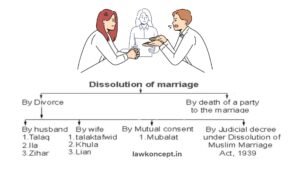
There are different types of divorce recognized under Muslim law, which can be mainly grouped as:
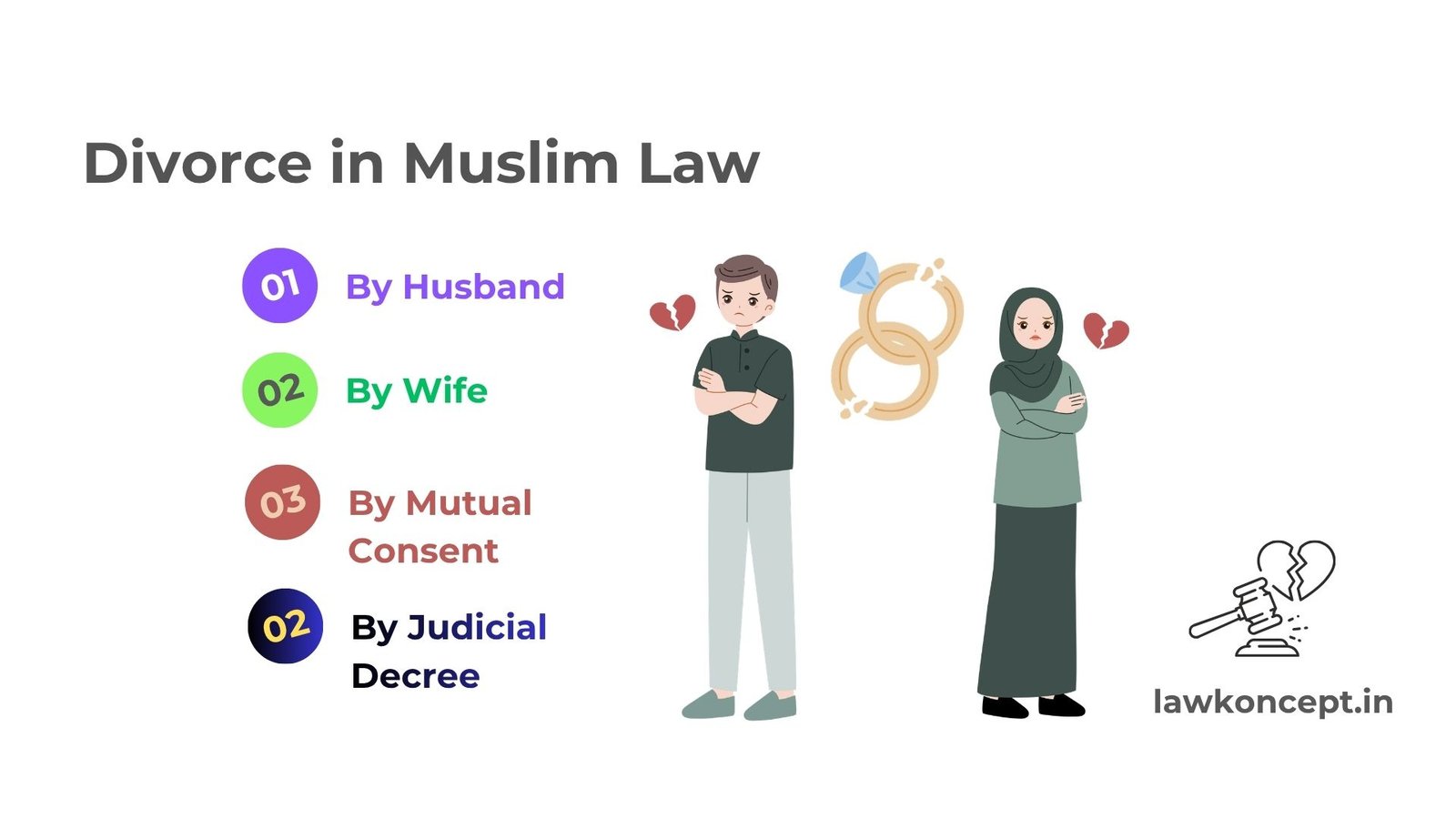
– Divorce by husband (Talaq, Ila, and Zihar)
– Divorce by wife (alaq-e-Tafweez, Lian, and Faskh)
– Divorce by mutual consent (Khula and Mubarat)
– Divorce by court order (or Faskh)
These are the easy classifications of divorce under muslim law. You can easily understand its kind by reading the description below. Each and every type of divorce is briefly explained.
By Husband:
Talaaq:
Talaaq is when the husband ends the marriage. In its basic form, it means the husband ends the marriage, either right away or after some time.Talaaq is a general term for all types of divorce, but it mainly refers to when the husband end the marriage.
In Shia law, a talaaq has to be said out loud in front of two witnesses.
In Sunni law, any adult and mentally sound man can say talaaq.
Talaq-ul-Sunnat:
This is the approved way of talaaq, based on the traditions of the Prophet Muhammad.
It is divided into two kinds:
Talaq-i-Ahsan: The husband says talaaq once when the wife is not menstruating.
She has to wait for three menstrual cycles (iddat) before she is free.If they have sex during iddat, the divorce is canceled.If not, it becomes final after iddat.This form is considered the best because it gives time for both people to think and maybe get back together.
Talaq-i-Hasan: The husband says talaaq three times, once during each of three months when the wife is not menstruating.
After each time, there must be no sexual relations.The first two times can be canceled, either by words or by having sex.If the third talaaq is said without any reconciliation, the divorce is final and cannot be changed.This also gives time for possible resolution.
Talaq-e-Biddat: Also called triple talaq, this is when the husband says talaaq three times in one go, like in one sitting or through text or phone.
However, in 2017, the Supreme Court of India ruled that triple talaq is unconstitutional.The Muslim Women (Protection of Rights on Marriage) Act, 2019, made it a serious crime to do triple talaq.
Ila:
Ila is a very rare way of ending a marriage. The husband takes a vow not to have sex with his wife for four months.If he holds up his vow and doesn’t have sex with her during that time, the marriage ends automatically.If he has sex with her within four months, the vow is broken and the marriage continues.
Zihar:
Zihar is another old and not often used way of divorce. Here, the husband compares his wife to a female relative that is not allowed, like his mother or sister.This implies that his wife is just as forbidden to him as that relative.The wife can refuse to live with him until he does something to make up for it.If he doesn’t, the wife can go to court to get a divorce.
By Wife:
Historically, Muslim law gave very few rights to women to end a marriage. But over time and with changes in the law, women now have some specific ways to get a divorce.
Talaq-e-Tafweez (Delegated Divorce):
This talaq-e-tafweez allowed under both Sunni and Shia law. Basically, it gives the wife the right to separate from the marriage based on what the husband has allowed. For example, he might give her the power to divorce him if he takes another wife or ignores her.
Key Points:
– Under this the wife can be granted this power at the time of marriage or later.
– She can have absolute power (she can use it when she wants) or conditional power (she can use it if something happens).
– Once she uses this power as agreed, the marriage is over.
Lian:
Lian means when the husband wrongly accuses his wife of having an affair.
If this is true, the wife can take legal action against him and get a divorce because of this false charge.
By Mutual Consent:
Khula:
Khula is when the wife starts the divorce process, but she needs the husband’s agreement.
She offers to give back her mehr (money she was promised) or gives some other form of compensation in exchange for the divorce.Once the husband agrees, the marriage is over.The wife has to wait for the iddat period after the divorce.
Key Features of Khula:
– The wife makes the offer, and the husband accepts it.
– The wife gives up her financial claims (mehr) or offers other compensation.
– Once the divorce is finalized, it can’t be taken back
– Khula is recognised in both Sunni and Shia law.
Mubarat:
Under this divorce, the husband and the wife both are happy to dissolve their marriage (mutually agreed).
Sunnis—when couple agrees to mubarat, all their rights and duties towards each other stop.
Shias – believe that for mubarat to be a proper divorce, the word talaq should also be said in Arabic. Except if the people is unable to speak Arabic. Otherwise, it’s not considered a divorce.
When both Shias and Sunnis agreed on mubarat (mutual consent), it cannot be taken back once it is completed.
Difference between Khula and Mubarat:
- Khula is a kind of divorce that is started entirely by the wife .
- In mubarat, either the husband or wife can start it.
- In mubarat, there is no need for the wife to pay back the mehr or give any compensation, unless both agree to it. Whereas in the case of khula, the wife has to return back the mehr (a compulsory gift given by husband to his wife).
In both cases, husband and wife must be agree freely to the divorce. There should not be any coercion or force in the dissolution of marriage.
Judicial Divorce (Faskh)
Dissolution of Muslim Marriages Act, 1939, was established with aim to protect Muslim women’s rights in india. That is why It gives a woman certain reasons to get a divorce from the court, which is also called faskh.
Reasons uner which a woman can ask for the Judicial Divorce under the 1939 Act:
– If nowhereabouts of husband for four years.
– The husband was unable to take care of her for two years.
– If the husband is sentenced seven years or more.
– The husband has not fulfilled his duties as a husband for three years.
– Her husband suffering from a serious illness like insanity, leprosy, or a severe sexual disease.
– The husband was not able to have children at the time of marriage and still can’t.
– If woman was married before she was 15 by her guardian. Then she has an option to end the marriage before she’s 18, provided the marriage hasn’t happened.
– The husband has treated her cruelly, including beating her, making her life difficult, being with bad people.
Apart from the above reasoning, any other reason that is accepted under Muslim law for ending a marriage. Must be hear by the court and it can dissolve the marriage if they think the reason sufficient for divorce.
Conclusion
Under Muslim law, the ways to end a marriage mix with old traditions, religious beliefs, and new laws. Old rules gave husbands more power to end marriages while new ones and court decisions have made sure both men and women have fair rights.
Especially for women, they have the right to dissolve her marriage if it necessary. Today, a Muslim marriage in India can end in several ways, including mutual agreement, through a court order, and in some cases, by the husband alone.